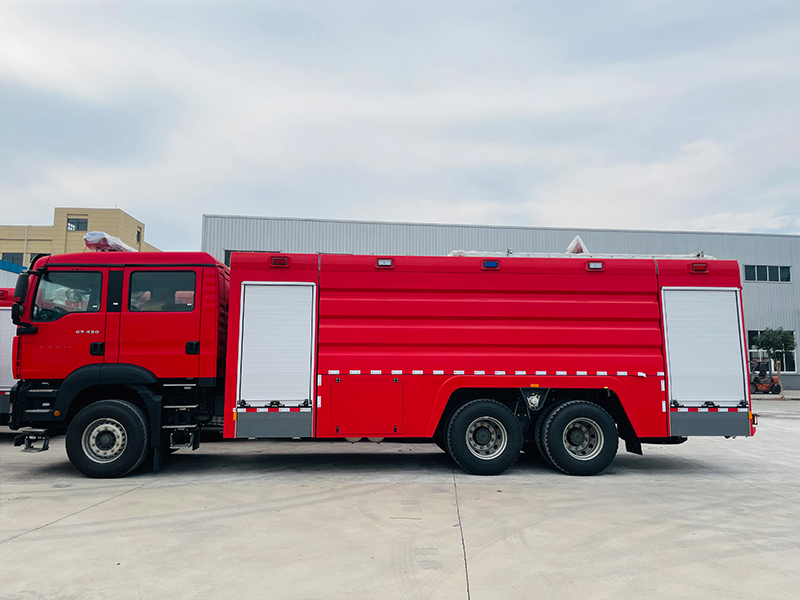
Industrial firefighting demands absolute precision in unforgiving environments. Petrochemical plants, aviation hubs, and manufacturing facilities present extreme hazards. You need rapid deployment and sustained suppression to prevent catastrophic losses. High-heat fires do not forgive equipment failure or inadequate agent supply.
Today, shifting environmental regulations complicate equipment procurement. Strict bans on PFAS and legacy AFFF mandate entirely new foam formulations. These sweeping changes force buyers to rethink traditional hardware specifications. You can no longer rely on legacy pump designs or standard piping to handle modern synthetic alternatives.
We will guide you through this complex transition. You will discover an evidence-based framework to evaluate, size, and specify an industrial foam fire truck. This guide ensures your next apparatus aligns perfectly with your facility's hazard profile. We focus on bridging the gap between rigorous regulatory mandates and practical suppression capabilities.
Key Takeaways
Hazard-First Sizing: Determine onboard capacities based on your facility's specific fuel loads, calculated application rates, and available municipal or site water supply.
Proportioning Precision Matters: Selecting the correct proportioning system (e.g., electronic vs. balanced pressure) dictates operational reliability and minimizes expensive foam waste.
SFFF Compatibility is Mandatory: Modern trucks must be engineered to handle the higher viscosity and distinct mixing requirements of Synthetic Fluorine-Free Foams (SFFF).
Total Cost of Ownership (TCO): Beyond the chassis and pump, long-term value is defined by vendor service SLAs, ease of maintenance, and hardware lifecycle.
Evaluating Your Specific Industrial Hazard Profile
Every industrial site presents unique suppression challenges. You must define your specific threat landscape before looking at apparatus specifications. Tank farms present massive, uncontained hydrocarbon fire risks. These environments require massive flow rates and extended suppression times. Chemical processing plants feature complex pipe racks and pressurized gas risks. Localized manufacturing might only need rapid, short-duration responses to protect specific machinery.
Understanding these differences prevents under-equipping your response team. A tank farm demands thousands of gallons per minute. A small manufacturing bay requires high maneuverability. We categorize these facilities to establish baseline performance metrics.
You must map your facility hazard class to precise NFPA 11 requirements. The National Fire Protection Association outlines the Standard for Low-, Medium-, and High-Expansion Foam. This standard dictates the exact application rates needed for different fuel types. Polar solvents require higher application rates than standard hydrocarbons. Establish your baseline performance metrics using these recognized calculations.
Best Practice: Always calculate your application rate based on your largest single hazard area.
Next, assess your existing site resources and infrastructure integration. Determine if the apparatus will act as a standalone suppression asset. Some trucks must carry all their own water and concentrate. Others connect directly to existing fixed foam systems and high-volume hydrants. Standalone units require massive onboard tanks. Integrated units focus more on pump capacity and proportioning speed. Evaluate your municipal or private water supply pressure before finalizing pump specifications.
Selecting the Right Foam Proportioning Technology
The proportioner serves as the beating heart of the apparatus. It accurately mixes the concentrate into the water stream under varying pressures. Reliable proportioning dictates your operational success. Too lean, and the fire continues to burn. Too rich, and you waste thousands of dollars of concentrate while depleting your limited supply prematurely.
Mechanical vs. Electronic Systems
You generally choose between two primary proportioning systems. Each system offers distinct advantages depending on your operational tactics.
Balanced pressure systems provide high reliability for fixed-ratio applications. These mechanical systems utilize a bypass valve to match concentrate pressure to water pressure. They excel in steady-state flow scenarios. However, they demand rigorous maintenance. Seals and bypass lines require frequent flushing to prevent blockages.
Electronic direct injection systems offer incredible precision. They utilize flow meters and microprocessors to inject exact amounts of concentrate. These systems excel in variable flow scenarios. You can open and close multiple nozzles without fluctuating the mix ratio. They drastically reduce concentrate waste. Note their heavy dependency on electrical systems. A voltage drop can compromise your suppression capabilities.
Viscosity Considerations
Modern concentrates present severe viscosity challenges. You must verify proportioning pump capabilities carefully. The pump must draft and inject highly viscous modern concentrates smoothly. Traditional centrifugal pumps often fail here. They cannot push thick liquids effectively.
Common Mistake: Failing to test the proportioner using the exact brand of foam you plan to deploy.
Specify positive displacement gear pumps for viscous agents. These pumps physically move the thick liquid regardless of resistance. They prevent cavitation and dangerous pressure drops. Cavitation destroys internal pump components rapidly. Ensure your plumbing diameter matches the pump intake requirements to facilitate smooth liquid flow.
Payload and Sizing: Specifying a Water and Foam Fire Truck
Determining onboard capacities requires strict mathematical planning. You cannot guess tank sizes when protecting industrial assets. We rely on standard rule-of-thumb formulas to estimate concentrate requirements. You base this on maximum flow rate and sustained application time.
Follow these standard calculation steps:
Identify the square footage of your largest potential fire hazard.
Determine the required application rate per NFPA guidelines.
Multiply the square footage by the application rate to find total gallons per minute (GPM).
Multiply the total GPM by the required suppression duration.
Multiply that total water volume by your concentrate percentage (e.g., 3%).
NFPA standards typically require a 15 to 20-minute minimum sustained application time. If your hazard requires 2,000 GPM for 20 minutes, you need 40,000 gallons of water. At a 3% ratio, you need 1,200 gallons of concentrate. This dictates your tank sizes.
Balancing these ratios on a dual-agent water and foam fire truck presents engineering trade-offs. Water weighs roughly 8.34 pounds per gallon. Concentrate weighs slightly more. Maximizing foam capacity reduces available water capacity. If your facility has excellent hydrant coverage, prioritize foam tank size. If water sources are scarce, prioritize a larger water payload.
You must respect weight and axle limitations. Overloading the chassis creates extreme risks. A truck carrying 3,000 gallons of liquid weighs over 25,000 pounds in payload alone. High-capacity industrial units require specialized multi-axle configurations. Tandem or tridem rear axles distribute weight safely. Proper weight distribution maintains maneuverability and road legality during emergency responses.
Navigating the Shift to Fluorine-Free Foam (SFFF)
The firefighting industry faces a massive regulatory reality check. Global environmental agencies mandate the rapid phase-out of AFFF. Per- and polyfluoroalkyl substances (PFAS) restrictions force departments to abandon legacy agents entirely. You must factor this reality into new apparatus procurement immediately.
Switching agents triggers significant hardware implications. You cannot simply drain the old tank and fill it up. SFFF behaves differently than legacy AFFF. Synthetic alternatives typically require higher application rates to achieve knockdown. They lack the film-forming capabilities of fluorinated agents. You rely purely on the bubble blanket for vapor suppression.
Furthermore, SFFF is often much more viscous than older concentrates. Legacy piping, standard valves, and narrow strainers may fail entirely. Thick agents clog standard mesh strainers. When a strainer clogs, the proportioning pump starves. This halts foam production instantly.
You must prioritize future-proofing the purchase. When specifying a modern Foam Fire Truck, demand oversized piping throughout the proportioning circuit. Standard 2-inch lines often need upgrading to 3-inch or 4-inch lines. Specify specialized foam pumps designed for non-Newtonian fluids. Choose corrosion-resistant tank materials carefully. Polypropylene tanks handle corrosive modern chemicals far better than traditional steel or aluminum tanks. They resist cracking and never rust.
Best Practice: Ask your manufacturer to certify the entire plumbing system for high-viscosity SFFF delivery prior to delivery.
Pump Performance, Monitors, and Apparatus Design
Industrial fires require overwhelming force. Pump GPM requirements dictate the fundamental design of your apparatus. Correlate your pump sizing directly with the facility's largest potential hazard. Municipal trucks usually feature 1,500 GPM pumps. Industrial facilities often demand pumps rated for 3,000 to 5,000 GPM or higher.
Pushing this much volume requires precise monitor placement. Evaluate the necessity of roof-mounted versus bumper-mounted monitors. Roof monitors provide excellent trajectory and reach over pipe racks. Bumper monitors excel at low-angle attacks underneath chemical processing units. You must analyze your specific site geography to decide.
Consider the operational safety benefits of wireless remote-controlled monitors. High-heat industrial zones present severe thermal radiation risks. Operators cannot stand on the truck deck safely during a full-scale tank fire. Wireless monitors allow personnel to direct the stream from a safe perimeter. This reduces exposure while maintaining pinpoint accuracy.
Chassis Type
Primary Advantages
Typical Use Case
Commercial
Cost-effective, standardized parts, easier local servicing.
Open facilities, wide access roads, budget-conscious departments.
Custom
Heavy-duty frame, tailored turning radius, specific cab layouts.
Tight refinery pipe racks, uneven plant terrain, max payload needs.
Chassis and terrain compatibility demand careful evaluation. Commercial chassis utilize standard commercial truck cabins. They are cost-effective and easy to service locally. However, custom chassis offer heavy-duty frames built specifically for emergency response. Custom units provide tailored turning radii essential for navigating tight refinery areas. Assess your plant terrain, road widths, and turning constraints before making a chassis decision.
Procurement Framework: Shortlisting an Industrial Foam Fire Truck Vendor
Buying complex apparatus requires a strict procurement framework. You must prioritize verification over manufacturer promises. Demand empirical flow-test data from all potential vendors. Do not accept theoretical specifications or marketing brochures. Require proportioning accuracy certifications under real-world pressure conditions. The system must perform flawlessly during variable flow tests.
Assess the vendor's regional service network rigorously. Service and support SLAs determine your operational readiness. Downtime leaves your facility vulnerable. An out-of-service apparatus could force operational shutdowns at highly regulated chemical plants. Verify parts availability and field technician response times. A beautiful truck holds no value sitting broken in the maintenance bay.
Evaluate customization transparency during the bidding process. Manufacturers must clearly explain how they handle engineering change orders. Complex builds always require mid-project adjustments. Assess their willingness to integrate third-party systems. You may prefer a specific proportioner brand. The manufacturer must accommodate these requests without voiding warranties. Discuss overall lead times frankly. Global supply chains fluctuate wildly. Get realistic delivery timelines written into the final contract.
Conclusion
Selecting the right apparatus demands a delicate balance. You must align advanced proportioning technology, massive payload capacity, and uncompromising SFFF compatibility. Your facility requires hardware tailored to precise hazard calculations rather than generic municipal standards. Precision prevents catastrophic failure.
Remember, the cheapest initial bid often results in severe operational risks. If the truck fails to integrate smoothly with your site infrastructure, you compromise safety. Purchasing undersized piping or incompatible proportioners forces premature and expensive retrofitting. You must prioritize long-term performance over short-term savings to ensure continuous facility protection.
We encourage all industrial buyers to initiate a formal hazard assessment immediately. Consult independent fire protection engineers before drafting your final RFP. Quantify your fuel loads, calculate your application rates, and test your new concentrates. Build your truck around the foam, the hazard, and the environment.
FAQ
Q: How much foam concentrate should an industrial fire truck carry?
A: The exact volume depends heavily on your facility's largest hazard area. You must calculate the required application rate and the necessary duration of suppression per NFPA guidelines. A standard minimum duration is 15 to 20 minutes. Larger tank farms may dictate massive onboard concentrate capacities exceeding 1,000 gallons.
Q: Can a standard water pumper be converted into a foam fire truck?
A: Converting a standard pumper involves extreme complexities and risks. Retrofitting high-volume proportioners and SFFF-compatible plumbing requires tearing down the apparatus. It often proves more expensive and less reliable than buying a purpose-built industrial unit. Legacy water pumps usually cannot handle the demands of highly viscous modern concentrates.
Q: What is the typical lead time for a custom industrial foam fire truck?
A: Lead times for custom industrial apparatus generally range from 18 to 36 months. This timeline factors in custom engineering, specialized component procurement, and ongoing supply chain realities. Specialized multi-axle chassis and high-volume industrial pumps often require extensive manufacturing lead times before assembly even begins.
Q: Do I need a different pump for SFFF compared to AFFF?
A: Yes, you frequently need a different pump. Modern fluorine-free concentrates are typically much more viscous than legacy AFFF. Standard centrifugal pumps often suffer cavitation and fail to move thick agents. Engineers increasingly recommend positive displacement gear pumps to handle the distinct viscosity and shear demands of modern SFFF.