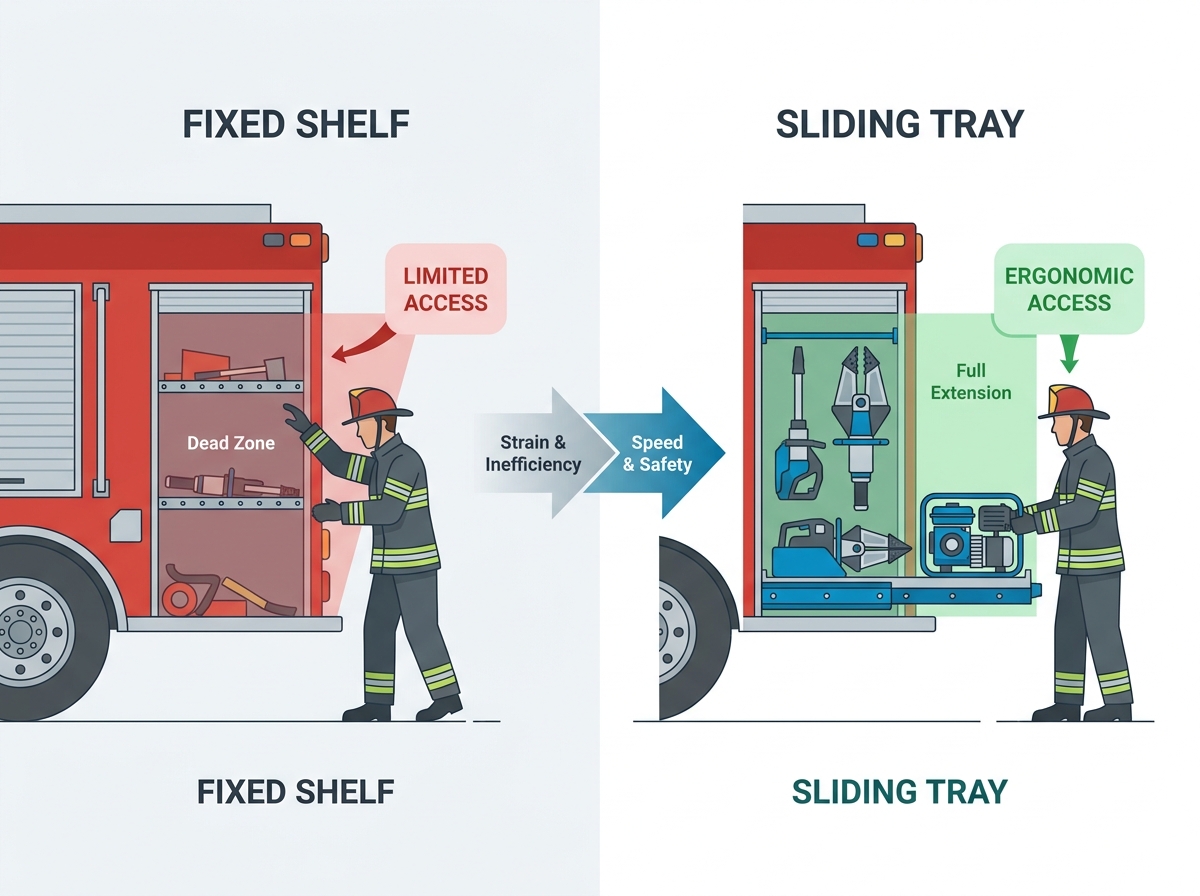
Specifying compartment layouts represents one of the most highly debated phases of custom apparatus purchasing. These structural decisions directly impact on-scene deployment times and daily crew safety. When seconds dictate incident outcomes, your gear must be instantly accessible. The choice between static mounts and pull-out systems involves much more than just the initial budget. Fleet committees must carefully calculate long-term ergonomics, space maximization, and available payload capacity. Poor compartment planning frequently leads to unnecessary physical strain, damaged extraction tools, and slower response metrics during critical incidents.
This guide breaks down the engineering, operational, and financial realities of both primary storage options. You will learn how to evaluate hardware footprints, dynamic load limits, and locking mechanism durability. Ultimately, we will help you specify the optimal setup tailored strictly to your operational needs.
Key Takeaways
Fixed Shelves offer maximum payload retention and lower upfront costs but often create inaccessible "dead zones" in deep compartments.
A Fire Truck Sliding Tray eliminates over-reach injuries and speeds up tool deployment, though it requires dedicating a percentage of payload capacity to the hardware itself.
The optimal fire truck storage system rarely relies on a single method; the best specs map the hardware to the specific weight, deployment frequency, and compartment height of the tools.
Locking mechanisms and extreme-condition durability (vibration, corrosion) are the primary failure points to evaluate when upgrading to sliding systems.
The Core Challenge in Apparatus Storage Design
Fire departments constantly face increasing demands to carry more diverse equipment. Modern crews haul comprehensive EMS bags, heavy battery-powered rescue tools, and specialized hazmat monitoring supplies. However, they must fit everything without expanding the overall vehicle footprint. Space constraints force difficult design compromises on every new build. These restrictions test the limits of standard chassis dimensions.
Deep compartments pose a severe ergonomic threat to your personnel across multiple shift rotations. They force firefighters to bend, reach, and lift heavy loads from severely compromised physical postures. Extrication tools, heavy strut systems, and portable generators represent massive, awkward weights. Pulling them out of deep recesses drastically increases costly workers' compensation claims. Chronic musculoskeletal fatigue degrades cognitive performance during extended fireground operations.
A highly successful compartment design directly addresses these specific occupational challenges. First, it minimizes the crucial time-to-tool metric during intense situations. Second, it protects highly expensive gear from transit damage caused by road vibrations. Third, it completely protects the firefighter from avoidable ergonomic strain. We must carefully balance physical capacity against established human performance limits to ensure long-term career survivability for responders.
Fixed Shelves: The Traditional Baseline
Fixed shelves represent the traditional foundation of apparatus design. Builders construct these rigid horizontal planes using bolted or welded marine-grade aluminum. Crews usually adjust them vertically via heavy-duty unistrut tracks mounted to the compartment walls. However, they remain entirely static during daily field operations.
These rigid platforms excel in specific operational scenarios. They are ideal for lightweight, bulky items like folded salvage covers, spare SCBA bottles, or scene lighting tripods. Fan storage also works well on static planes. Furthermore, they suit high-compartment placements perfectly. Deploying a heavy pull-out mechanism far above eye level creates severe overhead safety hazards.
Using fixed shelves offers several distinct advantages. They have zero moving parts, which equals virtually zero routine maintenance. This simplicity saves valuable mechanic hours. They also cause minimal intrusion into your total Gross Vehicle Weight Rating (GVWR). Furthermore, they represent a lower line-item cost on the initial apparatus build.
Despite these benefits, static shelving carries significant operational downsides. It guarantees poor accessibility for items stored in the rear 50% of the shelf. Firefighters call this inaccessible rear area the dreaded "dead zone." Critical secondary gear often gets pushed to the back, forgotten, and left uninspected. They also cause highly inefficient use of valuable vertical space. You always require significant extra clearance above the item simply to tilt and lift it over the front lip. This wasted overhead gap quickly consumes limited compartment volume.
The Case for a Fire Truck Sliding Tray
Modern apparatus design increasingly relies on dynamic movement systems. A heavy-duty sliding system utilizes full-extension drawer slides mounted securely to the floor or adjustable tracks. High-quality versions offer 100% to 120% extension rates, often referred to as over-travel slides. This completely clears the vehicle body for unhindered vertical access from multiple angles.
These dynamic platforms are ideal for heavy, frequently deployed items. You should position them primarily at waist or knee level. Hydraulic rescue cutters, heavy spreaders, portable positive pressure pumps, and battery-operated ventilation fans belong strictly on these moving mounts.
The primary advantages center around human performance. Ergonomics improve drastically because the system brings the tool directly out into the operator's strike zone. This allows for safe, neutral-spine lifting mechanics, drastically reducing lower back sheer forces. Speed also increases noticeably. Crews gain instant visual inventory and unhindered access to every item. Vertical efficiency improves because items are pulled out completely before being lifted. You can pack tools much closer to the compartment ceiling.
However, specifying these systems introduces a few strict engineering trade-offs. The heavy-duty hardware significantly increases the raw compartment base weight, eating into your payload capacity. You must maintain strict adherence to maximum load limits. Exceeding these limits causes premature bearing failure. They also require a higher upfront investment compared to static metal. Moving parts always introduce potential ongoing maintenance needs over the vehicle's long lifespan.
Head-to-Head Evaluation Dimensions
Comparing these solutions requires a strict engineering mindset. While sliding mechanisms maximize usable depth, the physical heavy-duty slide rails consume lateral space. The tray chassis itself eats up valuable vertical inches to accommodate structural cross-members. You must evaluate if the net gain in accessible depth genuinely outweighs this lost structural margin.
Load capacity calculations change dramatically between static and dynamic mounting systems. You must meticulously compare the static load ratings of fixed aluminum against the dynamic load ratings of moving rails. A commercial sliding equipment tray must be specifically engineered for extreme dynamic stress. Apparatus environments involve high-frequency vibration levels and severe off-axis loading scenarios. Crews often park on sloped highway shoulders or uneven ditch lines, severely stressing the bearings of fully extended slides.
Security and strict standard compliance form the final evaluation pillar. Equipment must remain completely secure during rapid transit to meet NFPA compliance standards regarding containment. You must evaluate the reliability of secondary latches carefully. Assess the primary and secondary tie-down points on both systems to prevent catastrophic tool ejection during unexpected maneuvers.
Compartment Configuration Comparison
Evaluation Dimension
Fixed Shelving
Dynamic Tray System
Hardware Footprint
Minimal physical space consumed
Reduces lateral and vertical margins
Load Rating Profile
High static resting capacity
Requires strict dynamic stress rating
NFPA Transit Security
Relies heavily on cargo netting
Requires robust primary mechanical latches
Ergonomic Safety
High injury risk for deep reaches
Neutral-spine lifting mechanics enabled
Implementation Realities and Specifying Risks
Specifying compartment hardware looks easy on blueprints but presents real-world challenges. The most common point of daily friction involves the locking mechanism itself. You must apply the strict "glove-friendly test" to every proposed hardware design. Ensure front-pull handles or dual-side latches can be reliably operated while wearing thick, NFPA-compliant structural firefighting gloves. Firefighters must actuate these mechanisms smoothly using only one hand.
Common Mistake: Approving a flush-mounted latch design without physically testing it wearing wet, bulky turnout gloves.
Materials and ongoing corrosion resistance represent another major specifying risk for coastal or northern departments. You should carefully evaluate the longevity of anodized aluminum versus powder-coated heavy steel construction. Aluminum saves crucial weight but may flex under extreme concentrated point loads. Furthermore, ensure slide bearings are fully sealed against the environment. They must be explicitly rated for high moisture and heavy road-salt chemical exposure. Unsealed bearings will quickly grind to a halt when exposed to winter magnesium chloride.
Fleet managers must also understand the stark differences between retrofitting and OEM installations. Retrofitting older apparatus with heavy-vehicle drawer slides involves significant engineering complexity. Floor reinforcement is almost always required to prevent structural tearing. The substructure must safely handle the massive cantilevered weight of a fully extended tray. Without engineered reinforced flooring, the chassis sheet metal will warp over time. OEM installations integrate these vital structural supports directly into the original body welding phase.
Shortlisting Logic: Designing Your Compartment Strategy
The smartest fleet committees build strict guidelines for compartment layouts. We recommend establishing a simple logic tree to determine hardware placement effectively.
First, apply the standard High/Low Rule. Default to fixed shelves or specialized drop-down mounts for upper compartments located above chest height. Never use standard pull-outs above eye level without a specialized tilt-down feature. Conversely, strictly mandate dynamic trays for low, deep compartments carrying heavy, awkward loads.
Second, utilize a proven Frequency and Weight Matrix to map your gear properly:
High Frequency + Heavy Loads: Always specify dynamic pull-out systems. This setup protects personnel during repetitive, stressful deployments.
Low Frequency + Light Loads: Always specify static shelves. This approach preserves your budget and maximizes payload efficiency.
High Frequency + Light Loads: Consider shallow static shelves or custom tool tracking boards.
Low Frequency + Heavy Loads: Mount these items directly to the floor on fixed tracking to keep the vehicle's center of gravity low.
Your immediate next steps require a comprehensive equipment audit. Weigh every single tool destined for a specific vehicle compartment. Verify your chosen slide load rating provides a minimum 20% dynamic safety buffer above your actual combined tool weight. This critical structural buffer accounts for the severe dynamic bouncing experienced during rapid emergency responses.
Conclusion
Neither storage option proves universally superior for every single compartment. Fixed shelves easily win on total payload efficiency, mechanical simplicity, and initial cost. Meanwhile, dynamic sliding platforms remain completely unmatched for heavy-tool ergonomics and rapid fireground deployment speeds.
We highly recommend adopting a structured hybrid approach as your fleet standard. Invest your budget heavily in sliding systems for heavy rescue tools and primary attack gear. Then, actively utilize static shelving for your bulk, lightweight, or secondary equipment. This balanced strategy maximizes both human safety and long-term mechanical reliability.
Start planning your next custom apparatus build proactively. We strongly prompt you to consult with a dedicated apparatus design engineer today. Request specific technical spec sheets for heavy-duty apparatus sliding systems. Mapping out these crucial details early ensures a safer, faster, and highly organized response vehicle.
FAQ
Q: How much weight can a typical fire truck sliding tray hold?
A: Capacity varies significantly by engineering design. Standard commercial slides typically hold between 250 and 500 pounds. Heavy-duty variants can support 1,000 pounds or more. Always remember a system's dynamic capacity while moving is substantially lower than its static resting capacity.
Q: Can I retrofit a sliding equipment tray into an existing fire truck?
A: Yes, retrofitting is entirely possible. However, you must carefully verify the structural integrity of your current setup. The process often requires reinforcing the compartment floor plate and verifying existing unistrut track strength to support the new cantilevered weight.
Q: Do sliding trays require regular maintenance?
A: Yes. You must conduct routine inspections of all primary locking mechanisms. Crews should regularly clear dirt and road debris from the physical slide tracks. Unless the system uses fully sealed bearings, periodic lubrication remains mandatory to ensure smooth deployment.
Q: Does a sliding tray reduce my available compartment space?
A: The mechanical rails consume minor physical volume, usually requiring one to two inches on each lateral side. However, the mechanism grants unhindered access to 100% of the compartment's depth. This improved accessibility almost always results in greater practical storage capacity.